
Specially designed contact lenses worn while you sleep that temporarily reshape the cornea — so some patients can see clearly during the day without traditional contacts or glasses. Ortho-K is also one of the approaches studied for slowing the progression of nearsightedness in children and teens.
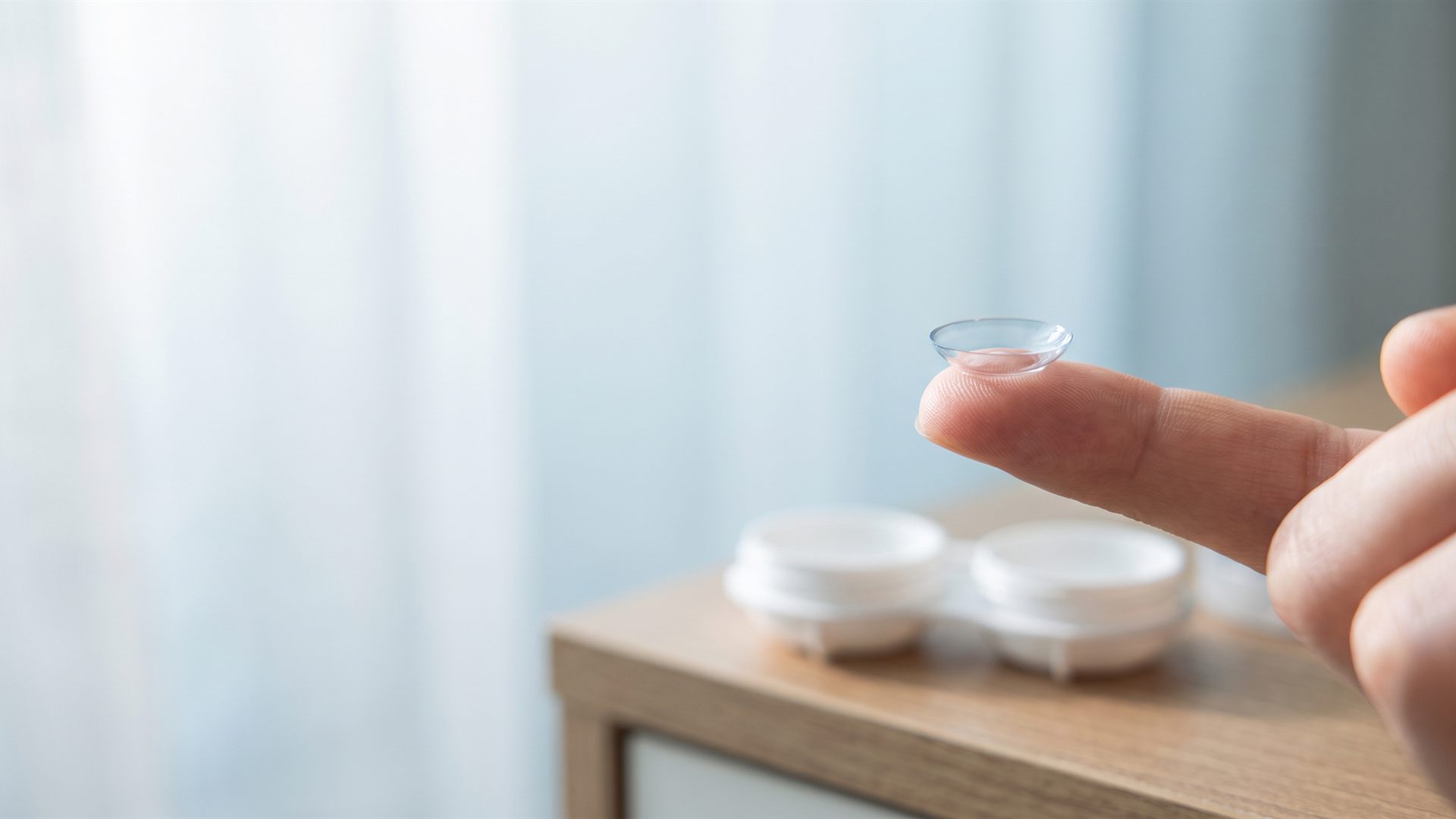
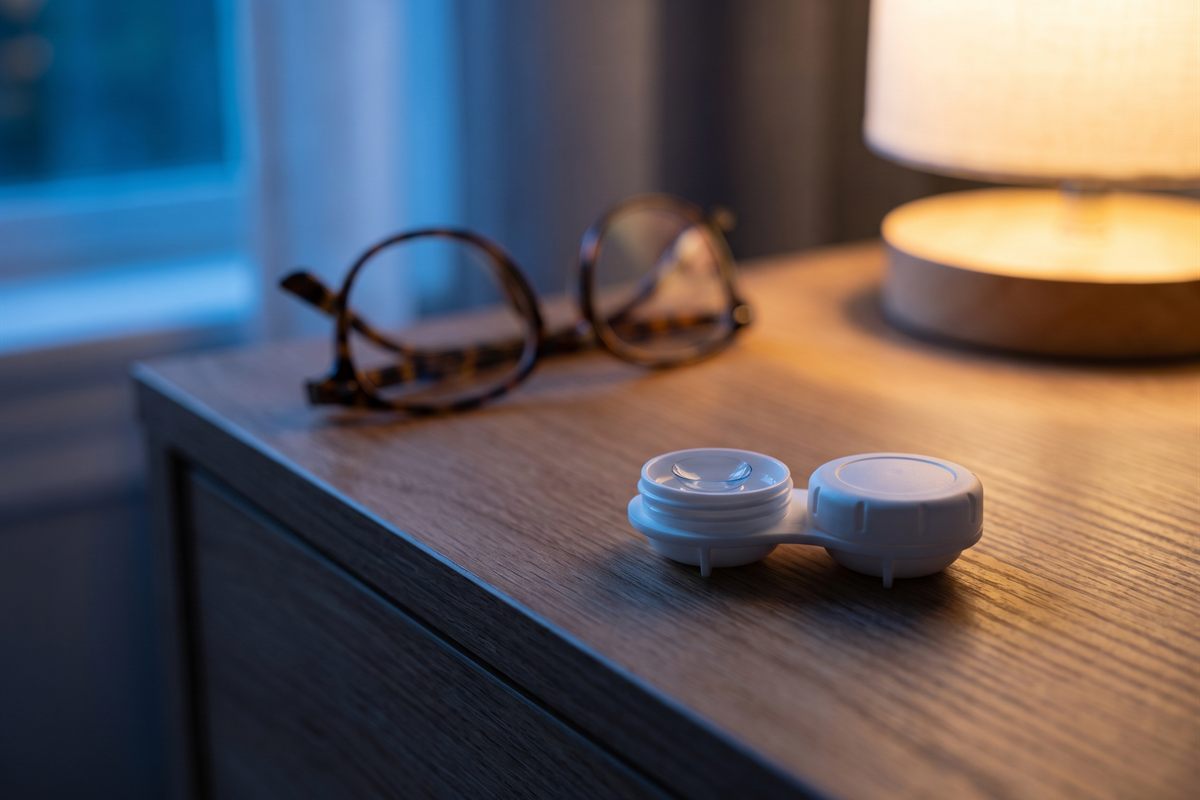
Orthokeratology, usually shortened to Ortho-K, uses specially designed rigid gas-permeable contact lenses that are worn while you sleep. Rather than correcting vision while they’re on the eye, the lenses do their work overnight: over the hours you wear them, they gently alter the shape of the front surface of the cornea — the clear dome at the front of the eye that does most of the eye’s focusing.
In the morning the lenses come out. The cornea holds its new, slightly flatter shape for a time, which lets light focus more appropriately on the retina, and for many patients that means clearer daytime vision without glasses or contacts. The change is temporary, so the lenses are worn regularly — usually every night — to maintain the effect.
The change to the cornea is small and controlled — measured in microns, not millimeters. The cross-sections below are simplified and exaggerated slightly so the idea is visible.
The Ortho-K lenses are placed on the eyes before sleeping, the same way any rigid lens is inserted.
The lens is a little flatter than the cornea. Over the hours of sleep, it gently changes the shape of the corneal surface beneath it.
The lenses come out on waking. The cornea keeps its temporary shape for a time, which can give clearer daytime vision.
Nothing is removed or cut. The reshaping happens in the cornea’s thin outer layer, and it reverses when the lenses aren’t worn — which is exactly why Ortho-K is both reversible and something that has to be kept up.

This is the reason most people ask about Ortho-K. After the lenses come out in the morning, some patients see clearly — or clearly enough for school, work, sports and driving — for the rest of the day without wearing glasses or conventional contact lenses.
A few honest caveats, because they matter:
No one can guarantee glasses-free vision, and we won’t. What we can do is measure your eyes, tell you what’s realistic, and fit the lenses carefully.
Correcting blurry distance vision and slowing how quickly nearsightedness gets worse are two different goals. Ortho-K is one of the approaches used for the second.
Myopia usually means the eye has grown a little too long for its focusing power. As a child grows, the eye can keep lengthening, and the prescription keeps climbing.
Myopia, or nearsightedness, most often develops in childhood and tends to progress through the school years as the eye grows. Glasses and ordinary contacts correct the blur but do nothing about the progression. Myopia management aims at the progression itself: slowing the rate at which the eye lengthens and the prescription increases.
Ortho-K has been studied as one approach to managing myopia progression in children and teens. Studies have generally found slower progression in children wearing Ortho-K compared with standard glasses or contact lenses, though responses vary from child to child and research continues. It is one option among several, and your eye doctor can determine which, if any, is appropriate for your child.
Higher levels of myopia in adulthood are associated with a greater lifetime likelihood of certain eye-health problems, such as retinal changes. That’s a reason to pay attention, not a reason to panic. Children whose prescription is changing benefit from early evaluation and regular monitoring.
Ortho-K is used by children, teenagers and adults. What they have in common is a prescription and a cornea the lenses can work with, and a willingness to keep up the routine.
Ortho-K generally isn’t appropriate for irregular corneas or keratoconus — for those eyes, scleral lenses are usually the better fit. Only an eye examination can tell you which category your eyes fall into.
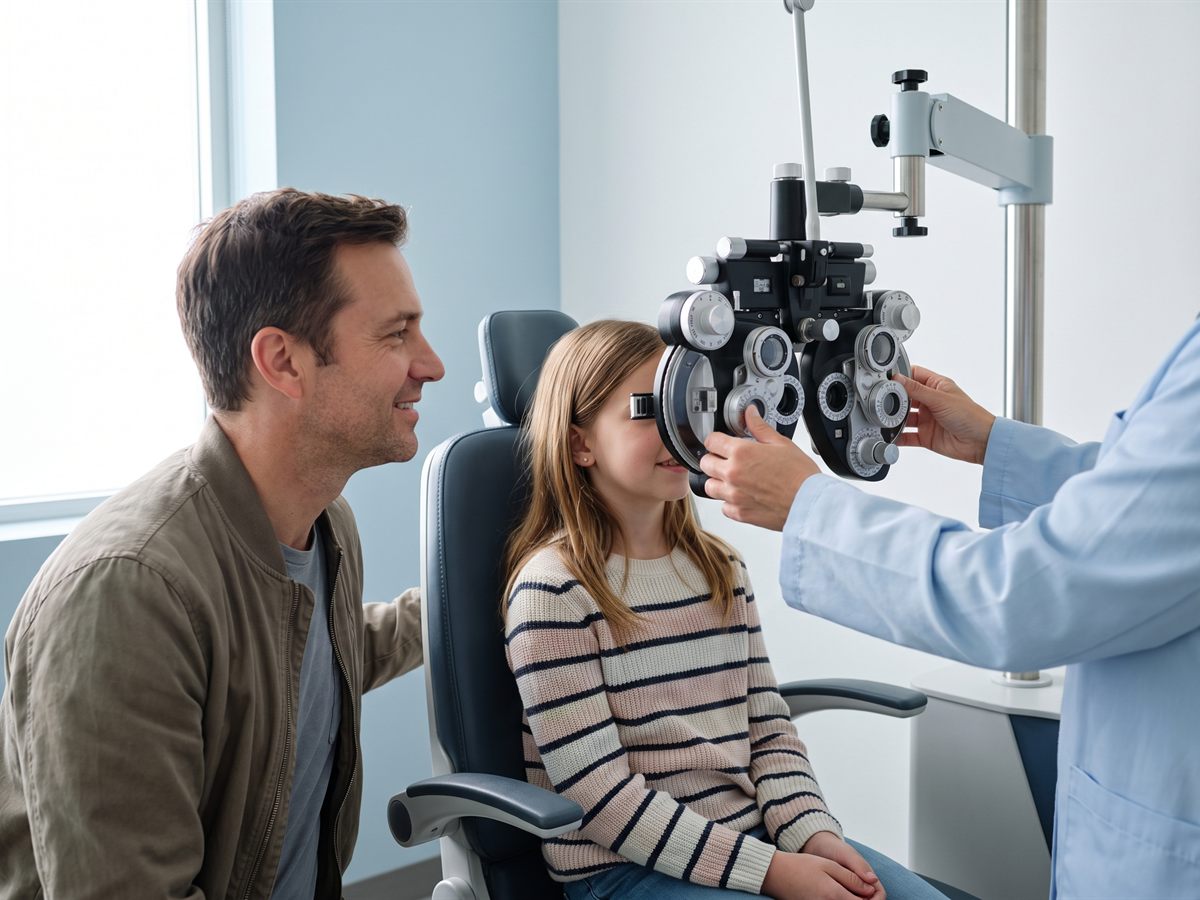
Parents usually come to Ortho-K for one of two reasons: their child’s prescription keeps going up at each visit, or their child is active and struggling with glasses or daytime contacts. Often it’s both. Here’s how we think about it.
Two comparisons patients ask for most. Neither option is universally better — each suits different eyes, ages and goals.
| Regular daytime contact lenses | Ortho-K | |
|---|---|---|
| When worn | During the day; removed at night. | Primarily overnight; removed during the day. |
| How they correct | Correct vision only while they’re on the eye. | Temporarily reshapes the cornea, so vision may stay clear after the lenses come out. |
| Designs | Many soft and rigid designs, including daily disposables. | Custom rigid gas-permeable designs approved for overnight wear. |
| Myopia management | Standard designs correct blur but don’t address progression; certain specialty daytime designs are used for management. | May be considered as part of myopia-management care for children and teens. |
| Ortho-K | LASIK | |
|---|---|---|
| Procedure | Non-surgical. Nothing is cut or removed. | Surgical. A laser permanently alters corneal tissue. |
| Permanence | Temporary and reversible; the effect fades when wear stops. | Intended to be permanent; not reversible. |
| Commitment | Continued overnight lens wear and ongoing follow-up. | A one-time procedure with its own recovery and follow-up. |
| Who it suits | Can be considered for children and teens whose prescriptions are still changing, as well as adults who prefer a non-surgical option. | Generally considered for appropriately selected adults with a stable prescription. Not a treatment for childhood myopia progression. |
This is general information, not a recommendation for any individual. Whether either option is appropriate for you is a conversation to have with your eye doctor.
Ortho-K is a fitted treatment, not a product you pick up. Here’s how it typically unfolds at our office.
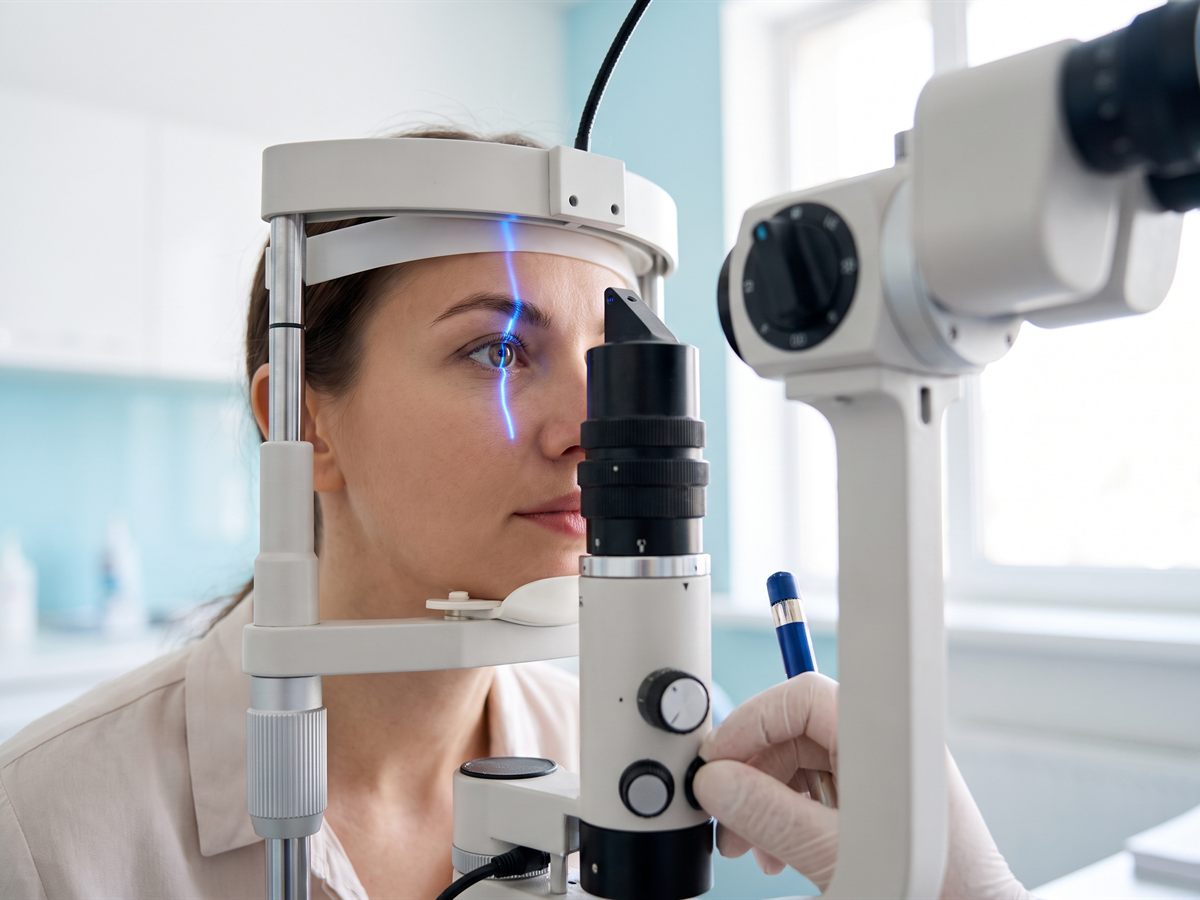
Ortho-K doesn’t end when the lenses are dispensed. Follow-up visits continue for as long as the lenses are worn, because the cornea’s response, the fit and the health of the eye all need to be checked over time.
Everything starts with a comprehensive eye exam: your vision, the health of the cornea and the rest of the eye, and whether Ortho-K is a reasonable option for you or your child.
Your prescription is measured precisely, and for children we look at how it has changed over time. That history is what tells us whether myopia management should be part of the goal.
Detailed measurements of the cornea’s curvature and shape are taken. Ortho-K works by reshaping this surface, so these measurements are the foundation of the lens design.
An Ortho-K lens is selected or custom-designed from your corneal measurements and prescription. The design determines how much reshaping the lens is intended to produce and where.
The lenses are placed on the eyes and the fit is checked. You — or you and your child — learn insertion, removal, hygiene and care, and practise until it’s comfortable.
The lenses are worn during sleep according to the schedule Dr. Grossman prescribes. Consistency matters: the effect builds and is maintained through regular wear.
Follow-up visits check your daytime vision, how the cornea is responding, the lens fit, the health of the eye and, for myopia management, how the prescription is tracking over time.
Some patients notice a difference after the first few nights; for others it builds over a couple of weeks. Vision can fluctuate a little during that period as the cornea settles into its new shape. How quickly it happens, and how complete the effect is, depends on:
We don’t promise a timeframe. Dr. Grossman monitors the response at follow-up visits and adjusts the lens design if the cornea isn’t responding as planned.
The reshaping is temporary. If the lenses aren’t worn as directed, the cornea gradually returns toward its original shape over days to a few weeks, and the underlying prescription generally comes back with it. Vision during that period may be somewhere in between, which is worth planning for — for example by keeping a pair of glasses on hand.
That reversibility is one of Ortho-K’s strengths: nothing has been permanently changed, and stopping is always an option. It also means Ortho-K is not a cure for myopia.
Ortho-K lenses are designed and approved for overnight wear, and many patients, including children, wear them for years without problems. But sleeping in any contact lens raises the risk of infection compared with daytime wear. That risk is managed, not ignored: with a proper fit, careful hygiene, the right care products and regular monitoring, it is kept low.
The essentials are few and firm:
These need to be checked the same day. Call (305) 466-0777; we provide urgent eye care.
Your specific products and schedule will be set at your fitting. The habits are the same for everyone.
Ortho-K suits some people extremely well and others not at all. Both columns are part of an honest picture.
Ortho-K is priced as a course of treatment rather than a pair of lenses, because most of the value is in the fitting, the follow-up and the monitoring. The total for your situation depends on several things, and we go over the fees for your case before you commit to anything.
Coverage varies a great deal. Many vision plans treat Ortho-K as elective and don’t cover it, while some plans contribute toward contact lens benefits or medically necessary lenses. We’ll check your plan before your visit so you know what to expect.
Call (305) 466-0777Straight answers to what patients and parents in Miami ask us most about orthokeratology.
Call and we’ll help you decide whether to book an Ortho-K evaluation, a myopia management visit, or a routine exam — and check your insurance while you’re on the line.
Call (305) 466-0777Ortho-K, short for orthokeratology, uses custom rigid gas-permeable contact lenses worn overnight to gently and temporarily reshape the cornea. After the lenses are removed in the morning, the reshaped cornea can allow clearer daytime vision without glasses or contacts. It’s non-surgical, reversible, and also used as one approach to myopia management in children.
The lens is slightly flatter than the cornea. While you sleep, it gently flattens the cornea’s thin outer layer by a small, controlled amount. That subtle change alters how the eye focuses light, so distant objects are clearer. The change is temporary and is maintained by continued overnight wear.
Yes. Ortho-K lenses are designed and approved specifically for overnight wear. They go in before bed, do their work during sleep, and come out in the morning. They are not normally worn during the day.
Many patients can, but results vary. Some see clearly all day; others have functional vision with a little blur late in the day or at night, and some still use a light prescription for certain tasks. No one can guarantee glasses-free vision.
No. The corneal reshaping is temporary and depends on continued overnight wear. If you stop, the cornea gradually returns toward its original shape and your underlying prescription returns. Ortho-K is not a cure for myopia.
Over days to a few weeks the cornea returns toward its own shape and vision goes back to roughly where it was before. Nothing has been permanently changed. During the transition, vision may be somewhere in between, so having glasses available is sensible.
Yes, Ortho-K is used for many children and teens, and it’s one of the approaches used in myopia management. Suitability depends on the child’s prescription, corneal shape, eye health and the family’s ability to manage hygiene and lens care reliably. A parent typically supervises younger children.
Ortho-K has been studied as an approach to managing myopia progression, and studies have generally found slower progression in children wearing Ortho-K compared with standard glasses or contacts. Responses vary from child to child, and Ortho-K doesn’t guarantee that myopia will stop progressing.
Ortho-K lenses are approved for overnight wear and are used safely by many patients, but sleeping in any contact lens carries a higher risk of infection than daytime wear. The risk is kept low with a proper fit, strict hygiene, the right care products, no contact with tap water, and regular follow-up.
Some patients notice clearer vision after the first few nights; for many the effect builds over a couple of weeks. The timeline depends on your prescription, your cornea, the lens design and how consistently the lenses are worn.
Because they’re worn with the eyes closed during sleep, most people are far less aware of Ortho-K lenses than they would be of a rigid lens worn during the day. There’s often some awareness in the first few nights, which usually fades. Persistent discomfort should be checked.
Often, yes, for lower amounts of astigmatism; some designs correct more than others. Larger or irregular astigmatism may fall outside what Ortho-K can address, in which case other specialty lenses may be a better fit.
Not in general — it’s different. Regular contacts correct vision while worn during the day and come in many convenient designs. Ortho-K moves the lens wear to night time and may add a myopia-management benefit for children.
Ortho-K is non-surgical, temporary and reversible, and requires continued overnight lens wear. LASIK is surgery that permanently alters corneal tissue and is generally considered for appropriately selected adults with a stable prescription.
There’s no fixed lifespan. Ortho-K lenses are rigid and durable, but material, care, handling, deposits and changes in the eye or prescription all affect how long a pair remains effective. For a growing child the design may need updating.
It varies with the evaluation, the lens design, the number of lenses, follow-up visits, replacement lenses and individual treatment needs. Ortho-K is priced as a course of treatment rather than a pair of lenses.
Coverage varies. Many vision plans treat Ortho-K as elective and don’t cover it; some contribute toward contact lens benefits. It depends on your specific plan — call (305) 466-0777.

The first step is an eye examination and Ortho-K evaluation. It tells us whether your prescription and cornea are suitable, what daytime vision you can realistically expect, and — for a child — whether myopia management should be part of the plan.
Serving Aventura, North Miami Beach, Sunny Isles Beach and the rest of North Miami-Dade · (305) 466-0777
This page provides general educational information about orthokeratology and myopia management and is not a substitute for an eye examination. Only an eye doctor who has examined your eyes can determine whether Ortho-K is appropriate for you or your child.
Conveniently located in downtown with ample parking. We accept most major insurance plans including VSP, EyeMed, and Blue Cross Blue Shield.
